Don't build a new food system. Use the one already feeding 500+ million people - more effectively.
NEST4All, Nutrition Equity and Sustainable Tomorrow for All, is where CSR funds and philanthropies back animal-free, plant-based nutrition innovation for school meal and maternal-&-adolescent-girl programmes in India (& South Asia), at less than 10 cents per person per day.
Why now
Animal-free nutrition with sustainability is the defining human capital problem of this generation.
- Yields went up, nutrient density went down: the cheapest calories are the emptiest.
- Hidden hunger lowers cognition, immunity, birth outcomes and earnings for life.
- It hits children, adolescent girls and women hardest.
- The fix must be animal-free: and fit the budget & the planet.
3B+
people cannot afford a healthy diet
FAO estimates roughly 2.8 to 3 billion people worldwide, the base layer of hidden hunger.
1 in 2
living with micronutrient deficiency
Lancet Global Health, 2022: 372 million preschool children and 1.2 billion women.
$3.5T
lost to the global economy each year
Healthcare costs and lost productivity attributed to malnutrition in all its forms.
$13B
annual financing gap for nutrition
World Bank: South Asia alone accounts for 34% of the 2025-34 requirement.
India carries the heaviest load
67.1%
of children anaemic; 57% of women (NFHS-5)
35.5%
of under-fives stunted, largely irreversible after 1,000 days
2-4%
of GDP lost every year to undernutrition
#1
largest young workforce this century, discounted before it starts
The urgency
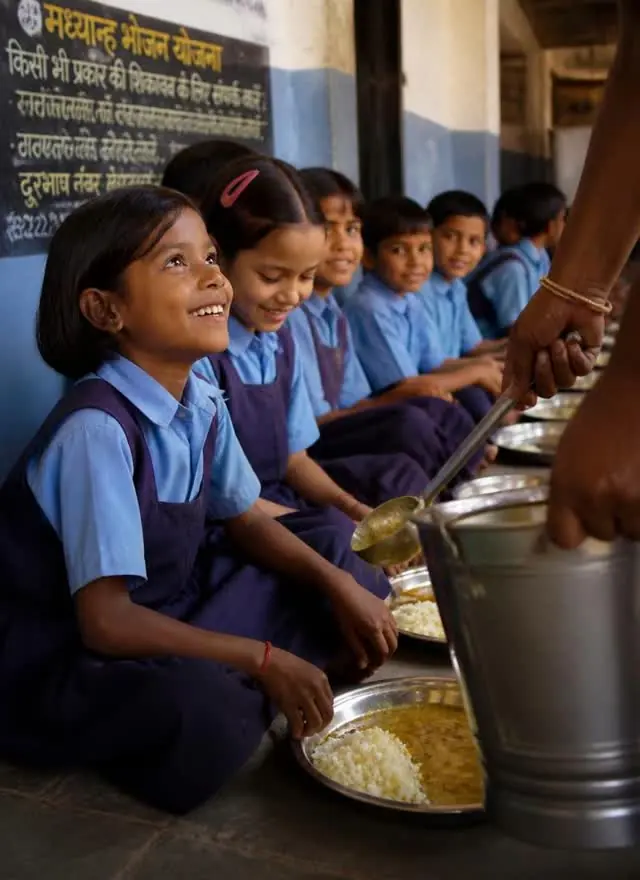
500+ million Indians already eat from these programmes every single day.
The fastest lever on earth for hidden hunger, sitting idle. Every year we wait is another cohort that never gets the cognition, height and immunity back.
Sources: Global Nutrition Report and World Bank estimates of the annual cost of malnutrition; Lancet Global Health (2022) on micronutrient deficiency prevalence in women and preschool children; NFHS-5 for India.
The scale
The delivery system already exists. The animal-free nutrition inside it does not.
India runs two of the largest feeding programmes on earth. The constraint is not reach, it is what can be bought for the per-plate budget.
100M
children reached by school meals in India
400M
women & adolescent girls via Anganwadi-linked programmes
₹8 (~8 cents)
food budget per child, per day
₹10-12 (~11-13 cents)
food budget per woman, per day
Why CSR and philanthropy specifically
India does not spend nothing on nutrition. It spends almost nothing on animal-free nutrition innovation.
FY2023-24 CSR expenditure totalled ₹34,909 crore (~$3.67 billion). Hunger and malnutrition received 3.5% of it, and only a sliver of that reached science, formulation or evidence generation.
Global picture
The World Bank estimates $13 billion of additional financing is needed every year to scale evidence-based nutrition interventions. South Asia alone accounts for $43 billion (34%) of the 2025-34 requirement.
Government budgets run the kitchens and buy the grain. They are not designed to fund the upstream science, formulation and validation that turns those meals into animal-free, higher-nutrition plates.
Only risk-tolerant corporate and philanthropic capital can fund that layer: discovering, formulating and proving nutrition and sustainability solutions worth adopting at government scale. That is the only thing NEST4All does.
Proof, not a pitch deck
Three MVPs already manufactured and lab tested.
Developed with DE3PBIO and evaluated by accredited labs: protein that matches dairy whey while costing less per gram digested, savoury staple formats at staple economics, and delivery science that makes added micronutrients count.
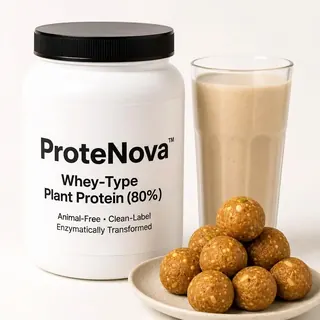
Beverage & sweet formats
ProteNova™
Enzymatically transformed pea and brown-rice protein, 80%. 96% digestibility, DIAAS 99, whey-type performance with no dairy and a lower cost per gram digested.
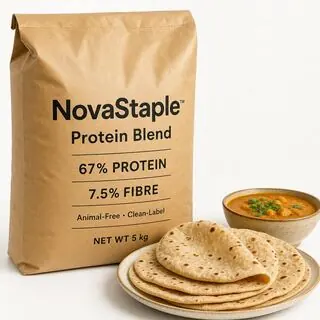
Savoury & staple formats
NovaStaple™
67% protein from protein concentrate, and soy, millet and sorghum fractions. 100% natural plant-fibre binder, no egg or dairy. Built for bread, biscuits, roti, khichdi, upma and dal at staple economics.
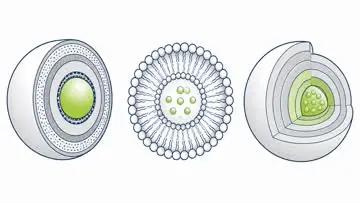
Micronutrient performance
Nova Absorption
Microencapsulation and liposomal delivery so iron, zinc, vitamin D and B12 survive cooking and get digested, instead of being fortified and lost.
Compliance ready
Approved food ingredients and enzymatic processing: US FDA and FSSAI compliant now, with no novel-food or GM pathway to clear.
Scalable today
No new bioreactor capacity, unlike precision fermentation. It runs on existing Indian food-processing lines at commodity economics, which is what makes a ₹8 (~8 cents) plate realistic.
Cow vs plants and enzymes
Two routes to the same protein. Only one fits the budget and planet.
Whey needs a herd. We use crops and food-grade enzymes to get the same protein performance, without the animal, at a fraction of the cost and footprint.
The animal route
Cow → milk → whey
Our route
Plants + enzymes → ProteNova™
20-30X more
emissions per kg protein; animal cruelty
96%
digestibility, PCDAAS 1, DIAAS 99; without animals / cruelty
Protein, plate for plate
One Scoop, or One Roti (Flat Bread)
Same protein and quality as dairy or eggs; more affordable
ProteNova™
Laddoo with 25g
NovaStaple™
1 Roti (40 g flour; 70% NovaStaple, 30% wheat)
600 ml
Milk
~₹30
110 g
Paneer (Cottage Cheese)
~₹45
570 g
Dahi (Yogurt)
~₹35
3 eggs
Eggs
~₹21
How we work, and how to fund it
Government pays for the meals. Our innovations make them better.
Formulate
Animal-free protein that beats dairy whey on digestibility and costs less per gram digested, built into everyday menus.
Validate
On-ground trials with reputed agencies such as Akshaya Patra and CSIR-CFTRI, generating extensive performance data.
Hand over
Recipes, specs and cost models go free to governments, school-meal kitchens and NGOs, so the results scale.
The ask
We are raising ₹3.09 cr (~$325k) for one 180-day validation programme.
It puts upgraded animal-free meals in front of 10,000 beneficiaries and produces the audited nutrition, taste and cost evidence needed to take it national. One CSR funder can carry it, or a few can share it. Everything it produces is released openly.
See the budget